
Becoming AI Native: Why Clarity is Now Your Competitive Advantage
The rules of business have fundamentally changed, but most organisations are still playing by the old playbook.
For decades, the primary constraint in business was execution. You had an idea, and the question was: can we build it? Do we have the resources, the talent, the time, the budget? The bottleneck was in the doing. Success belonged to those who could execute faster, build better, ship quicker.
That era is over.
The Execution Problem Has Been Solved
With AI, building is no longer the issue. What once took teams of specialists months to create can now be prototyped in hours. Code, content, designs, analyses, complex documents: all can be generated with remarkable speed and quality. The tools have become so capable that the act of building has been democratised beyond anything we've seen before.
But here's what most people are missing: we're still running around obsessed with execution when execution is no longer the constraint.
The New Bottleneck: Clarity
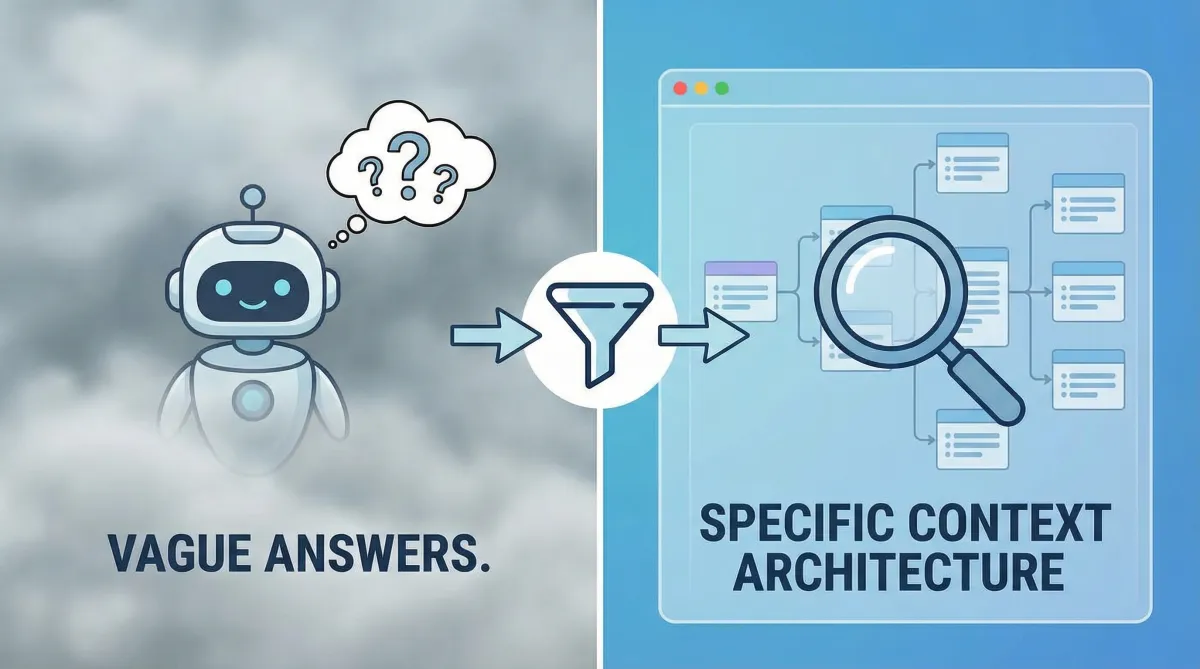
If building isn't the problem anymore, what is? The answer is deceptively simple: knowing what to build.
In an AI-native world, clarity is power. The quality of what you get out is directly proportional to the clarity you bring in. Not your technical skill. Not your years of experience with tools. Your clarity about the outcome you want.
Think about how most projects still start. Someone says "we need a better dashboard" or "let's redesign the website" or "we should automate this process." Then they rush into execution mode, gathering requirements, assigning tasks, building things. But they've skipped the most critical step: getting absolutely clear on what success looks like.
What problem are you actually solving? For whom? What does good look like? What matters and what doesn't? These questions aren't prerequisites to building anymore. They ARE the building.
From Prompting to Iterating
Even the concept of "prompting" is already outdated. Yes, how you communicate with AI matters. But the real skill isn't in crafting the perfect prompt. It's in the willingness to iterate.
In the old model, you planned extensively before building because changes were expensive. Every revision meant more time, more resources, more cost. So you front-loaded all the thinking into detailed specifications and requirements documents.
AI inverts this. Changes aren't expensive anymore. Iterations are cheap, sometimes instant. This means you can think through doing. You can see what you meant by building a version and then refining it. The prompt doesn't have to be perfect because you can course-correct in real-time.
But this only works if you've done the upfront thinking about direction and outcomes. You need to know what you're iterating towards. Without that clarity, you'll just iterate in circles, creating variations that are all equally mediocre.
The Iterate-Iterate-Iterate Model
Here's what AI-native work actually looks like:
Start with clarity. Spend real time understanding the problem, the user, the outcome. Not requirements, but outcomes. What does success feel like? What would make this genuinely valuable? Get specific. Get clear.
Then build a first version quickly. Don't aim for perfect. Aim for real. Get something tangible you can react to.
Now iterate. This is where the magic happens. Look at what you created and ask: is this it? What's wrong? What's missing? What's unclear? Then iterate again. And again. Each cycle should bring you closer to the clarity you started with, or reveal that your initial clarity wasn't quite right, prompting you to refine your understanding of the outcome itself.
The iteration isn't about fixing bugs or polishing details. It's about converging on truth. Each version is a conversation between your intent and reality.
Why Organisations Are Still Running the Wrong Race
Despite this fundamental shift, most organisations are still structured around execution as the bottleneck. They're optimising for build speed when they should be optimising for clarity speed.
They celebrate the team that ships fast but don't ask: did we build the right thing? They create processes to manage development but no processes to ensure clarity before development starts. They hire execution specialists but undervalue the people who ask hard questions about direction and purpose.
The result? Organisations that can build anything but don't know what to build. Speed without direction. Capability without purpose.
What It Means to Be AI Native
Becoming AI native isn't about using AI tools. It's about recognising that the constraint has shifted.
It means spending more time on the "what" and "why" before rushing to the "how." It means getting comfortable with ambiguity long enough to find real clarity rather than settling for the illusion of clarity that comes from jumping into action.
It means building thinking time into your process. Real thinking time. Not brainstorming sessions with stickies on a wall, but deep wrestling with the fundamental question: what are we actually trying to achieve?
It means embracing iteration not as a sign that you didn't plan well enough, but as the primary mechanism for refining both your creation and your understanding of what you're creating.
It means recognising that in a world where everyone can build, the scarce resource is clarity of purpose.
Clarity as a Skill
The good news is that clarity is a skill, not a gift. It can be developed. But it requires intention.
It means learning to sit with a problem longer before proposing solutions. It means asking "why" multiple times even when it feels redundant. It means describing outcomes in concrete, specific terms rather than abstract aspirations. It means testing your understanding by explaining it to others and seeing where you stumble or where they look confused.
Most importantly, it means accepting that thinking IS work. Perhaps the most important work. Not thinking about how to execute. Thinking about what to execute. Thinking about whether it's worth executing at all.
The Next Bottleneck: Distribution
But here's the twist that's already emerging: once everyone can produce high-quality work and iterate rapidly, we hit another bottleneck. Distribution.
If everyone can create compelling content, design beautiful products, and build sophisticated solutions, then the problem becomes: how do you get attention? How do you reach people? How do you break through the noise when the noise is produced by infinitely capable creators?
We're moving towards a world where production is abundant but attention is scarce. Where the ability to create is universal but the ability to be seen is rare. This isn't a distant future problem. It's happening now.
The same AI tools that democratised creation are flooding every channel with content. Every platform, every inbox, every feed is overwhelmed. The sheer volume of high-quality output is creating its own crisis. We solved the creation problem so thoroughly that we've made the distribution problem exponentially harder.
This means that clarity becomes even more critical, but in a different way. It's not just clarity about what to build. It's clarity about who it's for and how it reaches them. Distribution isn't an afterthought anymore. It can't be. If you build something brilliant but no one sees it, you haven't solved anything.
The organisations that understand this are already thinking about distribution from day one. Not as a final step, but as a core constraint that shapes what they build. They're asking: even if we build this perfectly, how will it reach people? What's our path to attention? What's our mechanism for breaking through?
Distribution might be the ultimate bottleneck because unlike execution (which AI solved) or clarity (which can be developed as a skill), distribution depends on systems, relationships, platforms, and networks that exist outside your control. You can be perfectly clear and build perfectly, but if you can't get your work in front of the right people, none of it matters.
This is where being AI native means thinking in systems, not just outputs. It means understanding that your competitive advantage isn't just what you build or how clearly you conceived it, but whether you have a credible path to getting it into the hands of people who need it.
The Competitive Advantage
In an AI-native world, your competitive advantage isn't your ability to build. Everyone can build. Your advantage is your ability to know what to build, and your ability to get it to the people who need it.
The organisations that will thrive are those that can achieve clarity faster, maintain it longer, iterate towards it more effectively, and distribute it more strategically. They'll ship the right things to the right people, not just ship things fast.
This is the paradigm shift that most have yet to internalize. We're no longer constrained by execution. We're constrained by clarity and distribution. The bottleneck has moved upstream and downstream simultaneously, and whoever masters both ends will win.
Clarity is power now. Distribution is the multiplier. Everything else is just details.
Live with passion & AI,
Brett