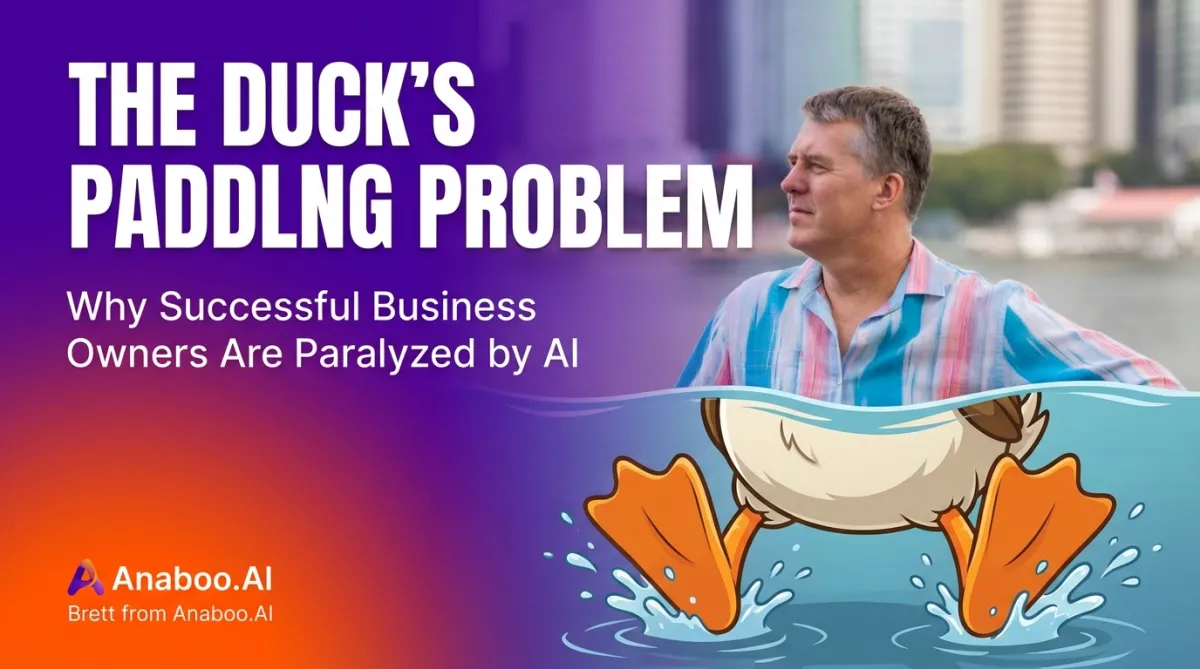
The Duck's Paddling Problem: Why Successful Business Owners Are Secretly Paralysed by AI
I was having coffee with a business owner in Singapore a few months ago. Late 40s, runs a service business with about 80 people. Revenue's solid, reputation's strong. From the outside, everything looks smooth.
Then he said something that's stuck with me ever since:
"I'm like a duck on water. On the surface, I look calm and in control. But underneath, my legs are going crazy just trying to keep up."
He wasn't talking about failing. He was winning. Just exhausted while doing it.
When I asked what was keeping him up at night, he didn't hesitate: "AI. Everyone says I need to implement it. But I don't know where to start. And I'm terrified of making the wrong decision."
If This Sounds Familiar, You're Not Alone
I've had this exact conversation dozens of times over the past two years. Singapore, UK, Australia, Southeast Asia. Different businesses, different industries, but the same underlying tension.
They're in their 40s and 50s. They've built or are running successful businesses. Teams of 20, 50, 100, 500 people. Respected in their industries.
And they're all thinking the same thing:
"I know AI matters, but I don't understand it."
"What's the impact on my business? What do I actually do? How do I get started?"
"I don't want to waste money on tools that don't deliver."
"I don't want to lose control of my ops."
"I don't want to lose the team I've spent years building."
What's interesting is they're not afraid of change. They've been pivoting their entire careers. That's how they got where they are.
They're afraid of making the wrong change at the wrong time with the wrong approach.
And honestly? They're right to be cautious.
Why Most AI Advice Doesn't Work for You
If you've been paying attention to AI over the past two years, you've probably heard the same advice on repeat:
"AI will replace 80% of jobs."
"Adopt AI now or fall behind."
"Use this tool to automate everything."
"Just plug ChatGPT into your workflows."
So you open ChatGPT. You ask it a basic question. It gives you an answer. Great.
Now what?
You listen to a podcast about AI disruption. You watch a YouTube video about automation. You read an article about how "every business needs AI."
And you close your laptop thinking: "I still don't know what to DO."
Most AI advice is written by tech people for tech people. It assumes you have a tech team. That you want to build custom AI tools. That you understand how LLMs, APIs, and integrations work. That you have time to experiment and fail.
But you're not a tech company. You're a business owner with 100 things on your desk, a team that relies on you, and clients who expect results.
You don't have time to "experiment." You need clarity and implementation.
The Real Problem Isn't AI. It's Decision Paralysis.
You're already successful. Your business works. You've built it through hard work, good decisions, and constant adaptation.
But just before the finish line, it changes.
The rules shift. The market moves. Technology evolves and you have to pivot...again.
You pick yourself up. You adjust. You bring your team along. Some staff leave. Some are frustrated. Some can't make the journey but don't leave—they just stay, quietly disengaged.
And you keep working harder and harder, more and more, just to keep what you had before.
Sound familiar?
Now add AI to the mix. Everyone's telling you that you MUST adopt it. But no one's telling you HOW in a way that makes sense for your business, your team, your pace.
So you're stuck. Not because you're incapable. Not because you're behind. Because you're waiting for clarity before you commit.
That's actually the smart move.
What You Actually Need (And Why No One's Giving It to You)
After 20+ years running businesses and implementing AI in my own operations, I've realized something:
You don't need another tool. You need a guide.
Someone who understands your world (not just the tech). Who speaks your language (not jargon). Who walks you through it step by step (not "just figure it out"). Who helps you bring your team along (not replace them). Who gives you control (not chaos).
AI isn't like other technology. It's not a new CRM you can just plug in. It's not accounting software you install and forget about.
AI touches everything—your processes, your people, your culture.
If you implement it wrong, you don't just waste money. You lose trust.
That's why most business owners freeze. They know the stakes are high. And they don't want to mess it up.
The Framework That Actually Works
Over the past few years, I've developed a 7-step process for implementing AI in small and medium businesses.
It's built for business owners who don't have a tech team, don't have time to waste, need practical solutions (not theory), and want to bring their team along (not leave them behind).
Step 1: Create a Plan & Strategy
Before you touch any tools, answer one question: "What's the one thing that's draining me right now?"
Not 10 things. One thing.
Is it constantly having to make decisions your team should make? Approving every invoice? Jumping in to close deals because your team can't?
Start there. Then we build a strategy around that one bottleneck. Clear. Simple. Measurable.
Step 2: Bring Your Team Onboard
This is where most implementations fail.
Business owners treat AI like a secret weapon. They implement it quietly, hoping the team will just "get on board."
But your team isn't stupid. They know what's happening. And they're terrified.
So instead of hiding it, we bring them in early. We explain what's changing, why it's changing, and how it makes their jobs better, not obsolete.
Your team doesn't hate change. They hate uncertainty. Give them clarity, and they'll follow you anywhere.
Step 3: Build Your Knowledge Base
This is the foundation of everything.
AI is only as good as the information you give it. If your company knowledge is scattered across emails, drives, heads, and handwritten notes, AI can't help you.
We create a centralized knowledge base—a single source of truth for how your business operates.
This isn't a tech project. It's a documentation project. And it pays off immediately.
Step 4: Analyse Your Data
Most businesses have data. They just don't use it.
We clean it. Sort it. Structure it. Then we teach you (and your team) how to ask the right questions.
Not "Give me a report." But: "What patterns am I missing? Where are we losing time? What decisions should I be making differently?"
Step 5: Deep Think
This is where AI gets interesting.
We combine human insight (your experience, your judgment) with AI reasoning (pattern recognition, scenario planning).
You're not outsourcing decisions to AI. You're augmenting your thinking so you can see options you wouldn't have seen before.
Step 6: Process Automation
Now—and only now—do we automate.
We start small. One process. One workflow. One bottleneck. We test it. Refine it. Make sure it works. Then we scale.
No "rip and replace." No chaos. Just steady, practical implementation.
Step 7: Regular Maintenance
AI isn't "set it and forget it."
Models change. Businesses evolve. Teams shift.
We build in regular check-ins—monthly reviews, quarterly strategy sessions—to make sure everything stays tuned, secure, and growing.
This is how you get from "I don't know where to start" to "My business runs on autopilot."
What This Looks Like in Real Life
I worked with a business owner in Singapore who runs an events company. Team of about 40. Revenue was solid, but he was drowning in approvals—every proposal, every budget, every client change had to go through him.
We didn't start by implementing AI. We started by asking: "What decisions do you make that your team should be making?"
Turns out, 80% of the approvals he was doing were repetitive—same type of client, same budget range, same process.
We built a simple decision framework. Documented it. Trained the team on it. Automated the notification system so he only got flagged for exceptions, not everything.
Within 3 months, his approval load dropped by 70%. His team felt more empowered. And he finally had time to focus on growth instead of firefighting.
That's what AI implementation should look like. Not flashy. Not hype. Just practical, grounded, and effective.
The Truth About AI and Your Team
The fear I hear most often: "What if my team hates me for implementing AI?"
When you implement AI with your team (not to your team), they don't resist. They embrace it.
Because they're just as tired as you are of answering the same questions over and over, redoing work that should've been done right the first time, chasing approvals, being stuck in manual, repetitive tasks.
Your team doesn't want to be replaced. They want to be empowered.
When you show them that AI can handle the boring stuff so they can focus on the meaningful stuff, they'll thank you for it.
So What's Next?
If you've read this far, you're probably thinking one of two things:
"This makes sense. But I still don't know where to start."
Or:
"This sounds great. But is it really this simple?"
My answer to both: It's not simple. But it is clear. And that's what matters.
You don't need to figure this out alone. You don't need to become a tech expert. You don't need to spend months experimenting.
You just need someone who's done it before to walk you through it—step by step.
Let's Have That Coffee Conversation
A simple, honest conversation. No sales pitch. No technical jargon. Just you, me, and a clear-headed discussion about where you are and where you want to be.
We call it the Coffee Conversation.
It usually takes 45 minutes. By the end, you'll have clarity on what AI can (and can't) do for your business, a sense of where to start, and a roadmap for the next 3-5 years.
No obligation. No pressure. Just clarity.
If you're a business owner or manager in your 40s or 50s, running a team of 20-500 people, and you wake up thinking "What's the impact of AI on my business? What do I do? How do I get started?"—this conversation is for you.
Book it below.
Live with passion & AI
Brett