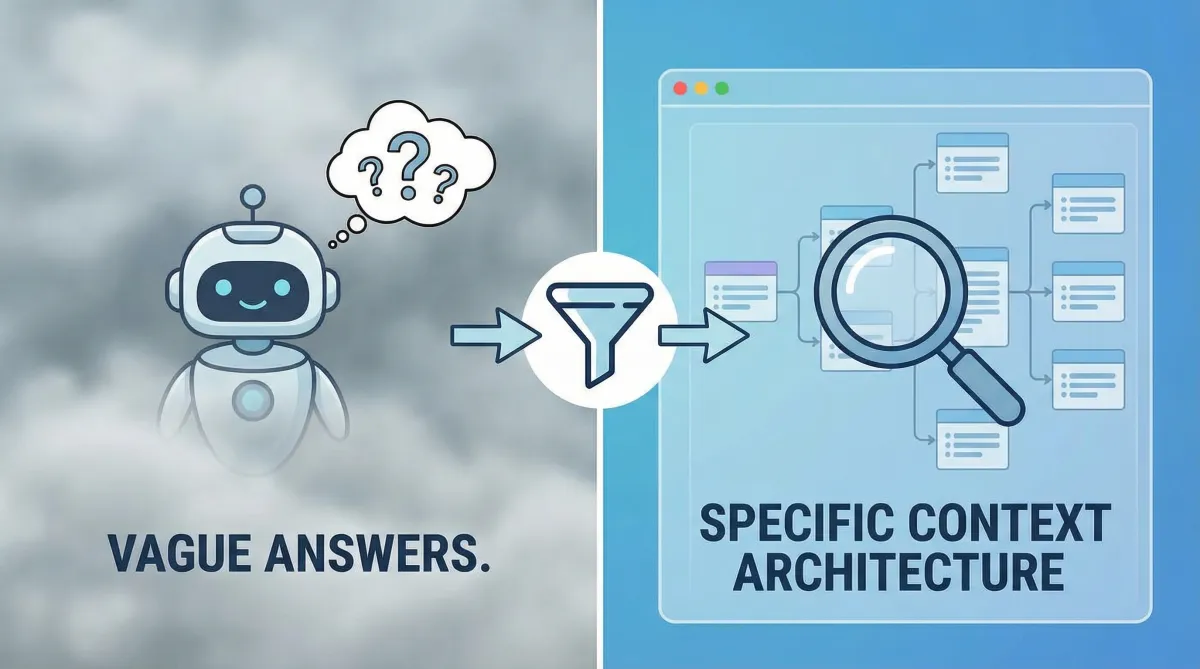
Why Your AI Gives Vague Answers — and How Specific Context Architecture Fixes It
Most AI implementations underperform for one reason: the AI is guessing.
Not because the model is weak. Because it has been given broad, generalised context and asked to figure out what is relevant. That produces outputs that feel almost right. Answers that could apply to any business. Suggestions that miss the specifics that actually matter.
There is a better way to build this. Anaboo's agentic and multi-agent AI systems are built on a specific context architecture. Each agent knows exactly what information to load for each task — no more, no less. The result is fewer tokens used, better outputs, and interactions that feel like they were built for your business specifically, because they were.
## The Problem With Broad Context
When you hand an AI a large document, or a pile of documents, and ask it to help you with a specific task, it has to search through everything to find what is relevant. It has to make assumptions. It fills gaps with general knowledge (training) rather than your specific knowledge.
This is how most AI tools work. It is also why most AI tools produce generic outputs.
The bigger the context, the more guessing happens. The more guessing, the less accurate the result. You also pay for every token the model reads, whether it needed to or not.
A finance agent that reads your full marketing strategy before generating an invoice is wasting tokens.
A customer service agent that loads your entire technical build history before replying to a complaint is producing slower, noisier responses.
The right information, loaded at the right moment, is what produces precision.
## Jake Van Clef's Context Architecture
Jake Van Clef developed the specific file structure that Anaboo uses to address this problem directly. The architecture is built around one principle: every agent gets exactly the context it needs for its specific task, and nothing else.
Here is how it works in practice.
Each area of the business — finance, operations, writing, marketing, research — lives in its own workspace. Each workspace has a CONTEXT.md file. That file acts as a routing table. It tells the agent: if you are doing this task, load these files and skip everything else.
A finance agent creating an invoice loads pricing rules and products-services. It does not load marketing guidelines or technical documentation. A marketing agent writing a blog post loads brand voice and style guide. It does not load inventory procedures or financial reports.
Every agent has a defined role, a defined set of tools, and a defined list of skills. The agent does not guess what it is supposed to do or reach for information it does not need.
When a task comes in, the agent reads its CONTEXT.md, loads the correct files for that specific task, does the work, and exits. No drift. No guessing. No token waste on irrelevant material.
## Why This Matters for Token Use and Output Quality
Tokens are the currency of AI interaction. Every word the model reads and produces costs tokens. When an agent loads a 10,000-word document to extract three relevant facts, you are paying for 9,997 words of noise.
Specific context architecture reduces that noise to near zero. Each agent loads a small, targeted set of files. The model is not searching, it is applying. The difference in output quality is significant.
When the context is tight and accurate, the model produces answers that are specific to your business rather than plausible for any business. A customer reply that uses your actual pricing, your actual procedures, your actual tone. A cash flow report that reflects your actual cost structure. An invoice that matches your exact pricing rules.
Broad context gives you outputs you have to rewrite. Specific context gives you outputs you can use.
## How Multi-Agent AI Works Inside This Architecture
A single agent handles one function well. Multi-agent AI is what happens when several specialised agents work together to complete a process end to end.
Each agent in the system has its own workspace, its own context files, and its own specific skills. When a task requires multiple functions, the agents hand work between themselves. The output of one agent becomes the input of the next. No human needs to coordinate that handoff.
Here is a concrete example. A new client enquiry comes in:
- The Research Director agent reads the enquiry, pulls any available intelligence on the company, and qualifies the lead against your criteria.
- The Sales Director agent picks up the qualified lead, checks the CRM for any prior contact, and drafts a personalised response.
- The Compliance Director agent reviews the outgoing message for any regulatory or legal risk.
- The Admin Director agent logs the interaction, updates the pipeline, and schedules a follow-up.
Each agent only loads what it needs for its specific step. The workflow completes without a human touching it. The output quality is high because each agent worked with precise, relevant context at every stage.
This is the difference between one generalist doing everything passably and a team of specialists each doing one thing well.
## What Anaboo Builds for Your Business
Anaboo's agentic and multi-agent AI service designs and deploys this architecture inside your specific business.
We start by mapping your actual processes. Not theoretical workflows. The real work that happens daily: who does what, what information they need to do it, where the handoffs happen, and where the time goes. That mapping informs exactly how the agent workspaces and context files get built.
Then we build the architecture to match. Each department in your business gets its own agent workspace. Each agent gets a CONTEXT.md that routes it to the right files for the right tasks. Each process that crosses departments gets a defined handoff point so agents can pass work between themselves cleanly.
The 7-step methodology is built into how the system gets constructed. It is not a separate service layer. It is the process by which the architecture gets deployed properly: understanding the business, onboarding the team, extracting the knowledge base, connecting the data, designing the decision logic, deploying the automation, and maintaining it over time.
What you end up with is a set of agents that know your business the way a well-briefed team member does. They do not guess. They do not pad outputs with generalities. They load what they need, do the work, and produce results that are specific to you.
## Who This Is Built For
This service is for established business owners who already have operations running, people in roles, and processes that work. The bottleneck is not capability. It is the volume of low-level, repeatable work that sits on your team's plate and on yours.
The specific context architecture works because there is real business context to work with. Your pricing, your procedures, your voice, your client history, your data. The more specific your business context, the more precisely the agents can act on your behalf.
Anaboo works with businesses across any industry, with up to 50 employees, in any geography. The common thread is an owner who wants AI doing the operational work accurately, rather than approximately.
"Business-AI-in-a-Box" Pre-built Agents
This is a computer with preinstalled Claude's LLM and Local models ready for explode your productivity. It is a separate computer that is used exclusively for AI and it 24/7 attached so that you can call on it when you need it and it employs and spins up agents with the right context for each task and hands off to the next agent once its done. All allowing a human to approve it's work at key points. Interested in knowing more
## The Starting Point
The process begins with a free AI audit it's more of a chat than an Audit but it will explain what's possible and how simple it is to implement successfully now. Things have gotten a lot more defined in the past 2 months. We look at where your time goes, which processes are repeatable, and which parts of your business would benefit most from an agent with specific context rather than a general AI tool that guesses.
Our Guarantee is a minimum of 5 hours a week saved.
Live with Passion & Fun,
Brett