Becoming AI Native: The Only Sustainable Path Forward
Most business owners I talk to have the same look on their face when AI comes up. It's somewhere between exhaustion and mild panic.
They've already got ChatGPT accounts nobody uses. Someone in marketing bought Jasper. Finance has some automation thing. The IT person keeps sending Slack messages about new tools. And every week there's another LinkedIn post from someone claiming they've automated their entire business with three prompts and a prayer.
Meanwhile, you're wondering if this is just going to be another failed change program. Another few months of disruption, another pile of money spent, another round of exhausted staff who just want to do their actual jobs.
I've built businesses for 35 years across four continents. I've seen every management fad come through. Six Sigma. Lean. Agile. Digital transformation. Each one was going to save us all. Most left behind a trail of abandoned Trello boards and middle managers who'd stopped believing in anything.
But this one's different, and I'll tell you why.
The Pick-and-Mix Disaster
Most businesses right now are approaching AI like they're at a buffet. Grab a bit of this, try some of that, see what sticks.
You get a ChatGPT license. Marketing finds some content generator. Sales starts using an AI email writer. Operations discovers workflow automation. Each tool sort of works. In isolation. For a bit.
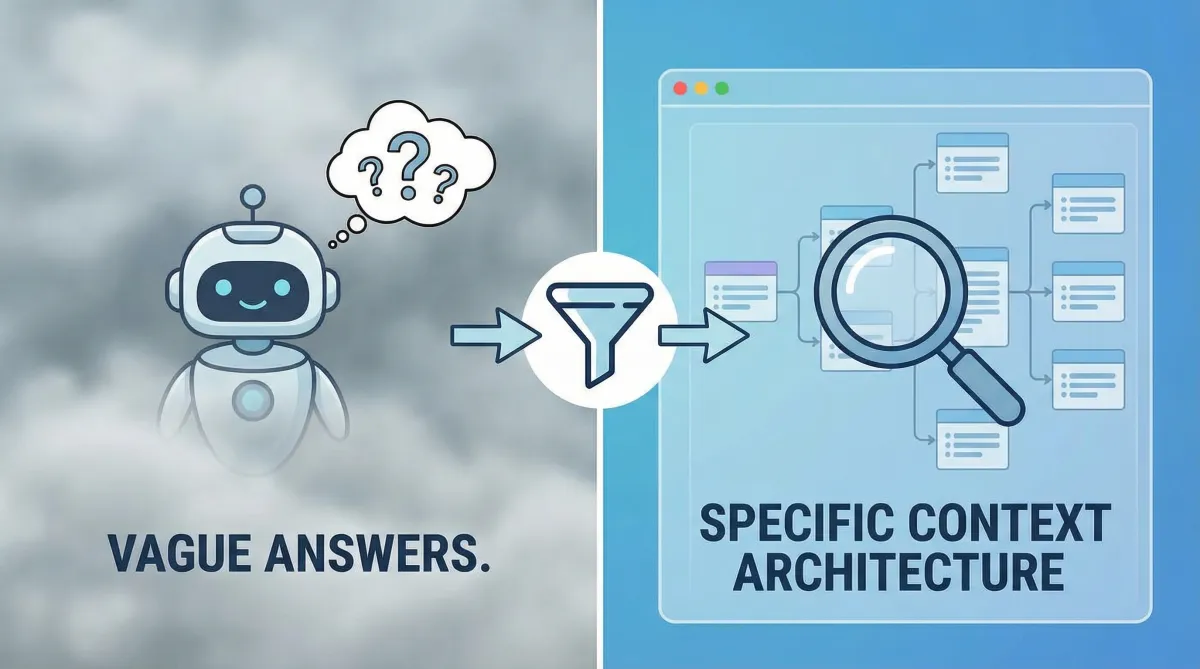
Then six months later, nothing talks to each other. The AI content doesn't sound like your brand. The sales emails contradict what marketing's saying. The automation breaks when someone changes a spreadsheet column. You've got seven different AI tools, none of which understand your business, and a team that's more confused than before you started.
I watched a manufacturing client spend £40,000 on AI tools last year. None of them integrated. Half didn't get used after month three. The other half created more work than they saved because someone had to manually bridge the gaps between systems.
They thought they were being smart by "staying flexible" and "seeing what worked." What they actually did was build a house by picking their favourite room from seven different floor plans. Sure, each room looks nice. But try living in it when the doors don't fit and the plumbing doesn't connect.
The problem isn't the tools. It's that they're building on sand.
What AI Native Actually Means
Strip away the jargon for a second.
Being AI Native doesn't mean everyone becomes a prompt engineer. It doesn't mean firing people and replacing them with robots. It doesn't mean you need a computer science degree to run a plumbing company.
It means you've built your business so AI understands how you work, not just what you want it to do.
Think about hiring someone new. You don't just hand them a task list and walk away. You show them how things operate around here. Your standards. Your quirks. The way you talk to customers. The decisions you make when things go sideways. Over time, they learn your culture. Eventually they can handle situations you never specifically trained them for, because they understand your business.
That's what AI Native means. You've taught your AI systems how your business actually works. Not just isolated tasks, but context. Values. Standards. The way decisions get made.
And when you build it this way, you're not trapped by whatever AI tool is popular this month. You've created something that works with any AI that comes along. When GPT-6,7 8 or 9 launches or some new platform emerges, you don't panic. You plug it in. Because your foundation - your strategy, culture, systems, processes - already works with intelligent systems, regardless of brand.
You've built the USB-C connector. Everything else is just hardware that plugs in.
Why You Can't Avoid This
Look, I get the resistance. This sounds like work. Can't you just keep bolting on tools as you find them?
Technically, yes. Practically, no.
Every disconnected tool costs you time training people on it. Every integration takes effort to maintain. Every mismatch between systems means someone manually fixing things. Your team spends more time managing AI than benefiting from it, and eventually they just stop using half of it.
The money adds up too. When you stack tools without a foundation, you're paying for overlap. You're paying for failed implementations. You're paying consultants to fix integration problems. And when you finally give up and rip it all out? Those sunk costs sting.
But worse than time or money is what happens to belief. Nothing kills team confidence faster than watching the third AI initiative fail to deliver. By the fourth attempt, they've stopped listening. Even good ideas die when belief is gone.
Meanwhile, your competitors who went AI Native six months ago are getting faster every week. They're compounding advantages while you're still trying to make three disconnected tools talk to each other.
I'm not trying to scare you. But the gap between AI Native businesses and everyone else isn't staying the same. It's widening. And it won't close by accident.
The Four Things That Actually Matter
Becoming AI Native rests on four things: Strategy, Culture, Technology, and Operations. Miss one, and the whole thing tips over.
Strategy: Know Why You're Doing This
Before you touch a single AI tool, you need to know why you're doing this and what winning looks like. Not vague aspirations. Concrete outcomes.
What matters? Not "we'll use AI" but "we'll cut response time by half" or "we'll give each team member back 10 hours a week for actual thinking."
Where does AI create real impact? You can't automate everything at once, so which workflows drain the most energy? Where do bottlenecks slow you down? What repetitive nonsense steals time from valuable work?
What does better actually look like? Define it. Measure it. Make it real.
Without strategy, you're just collecting tools. With it, you're building competitive advantage.
Culture: Get Your People On Side
The technology is the easy part. People are the hard part.
I've watched million-pound AI implementations fail not because the tech was wrong, but because the team didn't believe in it, didn't understand it, or actively worked around it. When people feel like they're being replaced, they resist. And when your team resists, no amount of clever automation saves you.
You need to earn belief. Remove ambiguity. Co-design solutions with the people doing the work, not impose them from a boardroom.
Your people need to see AI as making their jobs better, not making their jobs disappear. They need to understand that AI handles the tedious stuff so they can focus on work that requires judgment, creativity, actual human connection.
Your team already knows where the friction is. They know which tasks are soul-crushing. They know which processes are broken. When you ask them to help design the AI-enhanced version, they become champions. When you don't, they become saboteurs.
Culture isn't soft. It's the difference between implementation that lasts and implementation that collapses.
Technology: Build the Right Foundation
Now we get to the actual AI. Notice we're already at point three.
Most businesses think becoming AI Native means mastering algorithms and understanding machine learning models and becoming computer scientists. It doesn't.
It means building five components into your foundation:
Instructions. Your AI needs to know who it is - your brand voice, your values, your standards - and what you want it to achieve. Think of this as personality and purpose.
Knowledge base. Your AI needs access to your procedures, policies, templates, and context. The stuff that makes your business yours, not generic. When AI can reference your knowledge base, its outputs align with your standards automatically.
Tools. Your AI needs to do things - send emails, update systems, pull reports, create documents. Integrations turn AI from a chatbot into a worker.
Memory. Your AI should remember this conversation and previous ones. That's how it gets smarter over time and stops asking the same questions repeatedly.
Structured output. Your AI needs to deliver information in formats your team and your systems can actually use. No more copying and pasting between platforms.
You're not throwing AI at problems. You're teaching AI how your business works.
And once you've built these components, switching AI platforms is straightforward. You're not rebuilding from scratch when GPT-5 launches. You've built the foundation that works with whatever comes next.
Operations: Make It Work in the Real World
This is where AI actually changes how work gets done. And where most AI projects either work brilliantly or fail quietly.
Automation without oversight is dangerous. Oversight without systems is exhausting.
For high-stakes decisions, AI drafts and recommends. Humans review and approve. Nobody gets fired by a machine. No customer gets an AI response that misses the nuance.
Every automation has an undo button. Every process includes feedback. You're building systems that learn and improve, not brittle workflows that break at the first exception.
And you maintain it. Prompts drift. Data changes. Context evolves. Regular reviews - monthly or quarterly - keep quality high and catch drift before it becomes a problem.
This is where remote workers become essential, actually. AI handles speed. Remote workers handle context, quality control, and the edge cases machines can't navigate. Together, they create something that scales without falling apart.
How to Actually Get There: The Anaboo 7-Step Approach
Those four pillars - Strategy, Culture, Technology, Operations - sound sensible enough. But how do you actually build them without it becoming another sprawling, never-ending transformation project?
That's what the 7-step approach solves. It's a roadmap that takes you from where you are now to AI Native without the chaos.
Step 1: Create a Plan & Strategy
Decide why AI matters for your business. Which outcomes will you measure? What does 'better' look like? This is where you build clarity so you don't end up wandering. If the business impact is unclear at this stage, pause. Clarity today prevents chaos tomorrow.
Step 2: Bring Your Team Onboard
Earn belief. Remove ambiguity. Co-design small wins so adoption sticks. This isn't a nice-to-have. It's the step that decides whether everything else works or not. Your team needs to understand what's happening, why it matters, and how they benefit. Without that, the best technology in the world sits unused.
Step 3: Build Your Knowledge Base
Capture your procedures, tone, templates, FAQs - all the context that makes your business yours. This is how AI stops being generic and starts being aligned with your standards. When AI can reference your knowledge base, it works with context, not guesswork.
Step 4: Analyse Your Data
Clean your inputs. Define your fields. Decide what you'll trust. Good analysis prevents bad automation. This step is where you stop hoping your data is good enough and actually make it good enough. Because if you automate messy data, you just get mess faster.
Step 5: Deep Think
Combine your team's judgment with AI reasoning to stress-test options and design better processes. This is where you use AI not just to do tasks, but to help you think through problems. What are we missing? What could go wrong? What's the better way to structure this?
Step 6: Process Automation
Implement reviewable and reversible automations with a human in the loop where it matters. You're not flipping a switch and hoping. You're building systems where AI handles the predictable work, humans handle the judgment calls, and everything can be reviewed and improved.
Step 7: Regular Maintenance
Review prompts, logs, outcomes. Tidy, tune, and scale strategically. This is the step most businesses skip, and it's why their AI implementations drift into uselessness. Regular maintenance keeps quality high and catches problems early.
These seven steps map directly to those four pillars. Steps 1 and 2 build your Strategy and Culture. Steps 3, 4, and 5 build your Technology foundation. Steps 6 and 7 make Operations work and keep them working.
It's not a theory. It's a tested path from where you are to where you need to be.
Future-Proof and Platform-Independent
Right now, the AI landscape is chaos. New models every month. Pricing changes every quarter. Features appear and disappear. Platforms merge or shut down. Keeping up is exhausting and probably impossible.
But when you're AI Native, you don't care which specific platform you're using. Your knowledge base, your processes, your culture - they work with any intelligent system.
GPT-8 comes out? Plug it in. Google launches something new? Test it. A startup releases specialised AI for your industry? Evaluate it. Every transition is smooth because your foundation is solid.
You've become the USB-C connector that works with everything.
Compare that to the pick-and-mix approach. Locked into specific tools. Rebuilding with every change. Praying your vendors don't pivot or shut down. That's fragility disguised as flexibility.
AI Native is actual resilience.
This Isn't Another Change Program
I know you're tired of change programs. Your team groans when someone announces the next transformation initiative. You're worried this becomes another expensive distraction that dies in six months.
So let me be direct. Becoming AI Native is not a program. It's not a project with a finish date. It's a permanent shift in how your business operates.
It doesn't mean everything changes overnight. It means you build step by step, win by win, with your team designing the future instead of having it imposed.
It doesn't mean perfection. It means progress. Reviewable. Reversible. Human-led.
And it doesn't mean gambling on whatever AI tool is trendy this week. It means building a foundation that makes your business stronger and more adaptable, regardless of which specific tools come and go.
Where to Start
You probably already see three places where AI could take weight off your team. The question is which one first and how to avoid making this another failed initiative.
You don't have to figure it out alone. The 7-step approach works because it's built on 35 years of solving real business problems, not theoretical AI concepts. We've tested it across industries, countries, and business sizes.
Becoming AI Native isn't about being perfect. It's about being intentional. Building a foundation that protects your business from constant change while positioning you to grab every advantage AI offers.
The pick-and-mix approach is easy to start and expensive to sustain. AI Native requires more thought upfront and pays compounding returns forever.
Your competitors are choosing their path right now. Some are building on sand. Some on rock.
Which are you building on?
If you want to talk through what this looks like for your specific business, book a coffee conversation below or at www.anaboo.ai. No pitch. No pressure. Just a conversation about where you are, where you want to be, and whether this approach makes sense for you.
Live with passion & AI,
Brett