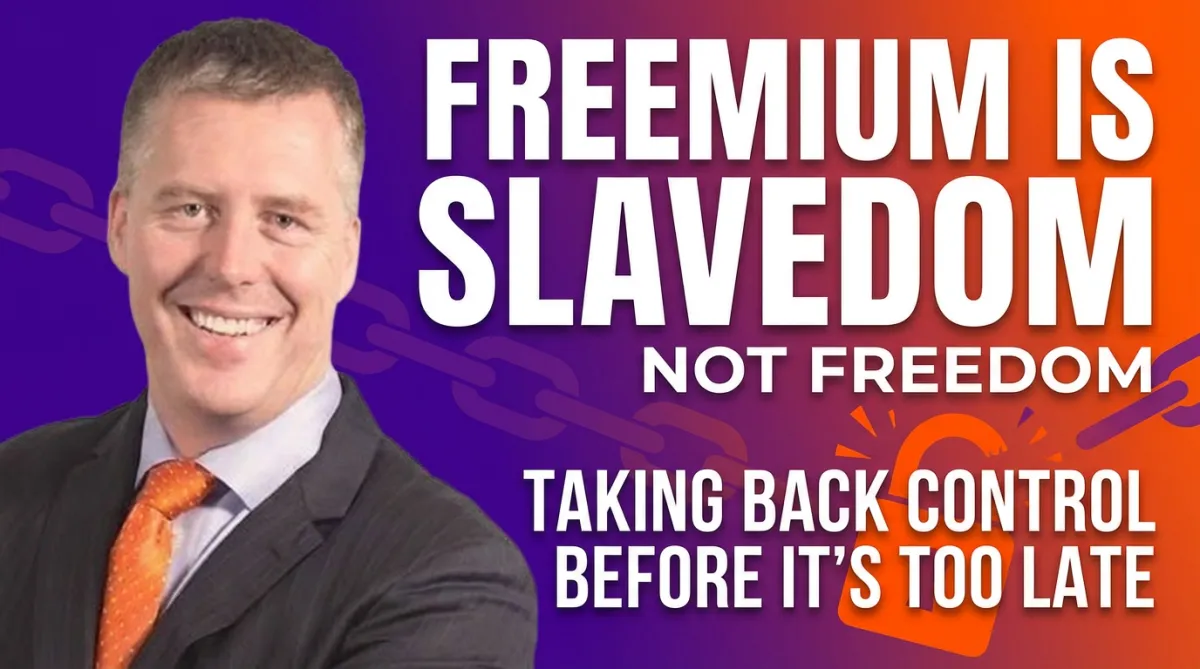
Freemium Is Slavedom, Not Freedom: Taking Back Control Before It's Too Late
We thought they were being generous.
Google gave us free email. Facebook gave us free social connection. Instagram gave us free lifestyle sharing. Microsoft gave us free apps. Apple gave us free services. We smiled, clicked "I agree," and thought we'd won the lottery of the digital age.
We were wrong.
What they actually did was far more insidious. They didn't give us anything. They took ownership of our data, mapped our behaviours, catalogued our preferences, and used that intelligence to control us. We didn't become their customers. We became their product.
And now, as we nervously debate government digital IDs and surveillance, we're missing the uncomfortable truth: we already gave away everything that matters. We handed it to corporations willingly, wrapped it in a bow, and signed terms and conditions we never read. Worse still, that data doesn't just sit in a vault somewhere—it actively shapes how we think, what we see, what we believe, and ultimately, who we become.
The Bait and Switch: How "Free" Became Expensive
Let me tell you a personal story. I started with free Gmail for my business. It was brilliant—clean interface, reliable, no cost. Then Google Workspace appeared at £9 per user per month. Fair enough, I thought. Professional features, support, worth it.
Today? It's upwards of £30 per user per month.
But here's the kicker: do I have privacy? Do I trust what Google says about my data? Or have I signed my rights away in those 100+ page privacy policies and terms of service that nobody actually reads? And what about the next update—did I mistakenly agree to hand over even more when I clicked "Accept" just to keep working?
The freemium model didn't stay free. It became expensive. And you're still the product. Only now you're paying for the privilege of being exploited.
This isn't just Google. It's everywhere. LinkedIn, Dropbox, Slack, Zoom—services that started free or cheap, then gradually increased prices while simultaneously expanding their data collection. We're paying more and getting less control. The deal got worse, and we're too invested to walk away.
You Already Gave Away Your Digital Soul
We panic about government digital IDs and centralised control, and we should. But let's be honest: we already handed over far more than any government could demand.
Facebook knows your relationships, your political leanings, your emotional patterns. Google knows your searches, your location history, your travel plans, your health concerns. Amazon knows what you buy, when you buy it, what you've considered buying. Apple knows your messages, your photos, your biometrics. Microsoft knows your documents, your work patterns, your collaboration habits.
Combined, these corporations know you better than you know yourself. They can predict your behaviour, influence your decisions, and shape your worldview—all while you scroll, completely unaware of the manipulation happening in real-time.
The algorithm decides what you see. Not you. It curates your reality, amplifies your biases, and keeps you engaged. Not informed. Not enlightened. Engaged. Because engagement equals data, and data equals profit.
You think you're making choices. You're not. You're responding to stimuli carefully designed by machine learning models trained on billions of data points. You're Pavlov's dog, and the bell is your notification chime.
The AI Endgame: Terminator or 1984?
Now add AI into this equation.
We're not talking about helpful chatbots and productivity tools. We're talking about artificial intelligence that can generate content indistinguishable from human writing, manipulate images and video with perfect realism, predict societal trends, and automate decisions that affect millions of lives.
In a world full of AI, how do we avoid ending up in Terminator or 1984?
The honest answer? We might not.
If we continue down the current path—handing over our data, accepting whatever terms are put in front of us, trusting corporations and governments to act in our best interest—we're building the infrastructure for total control. Not control by machines run amok like in Terminator, but something arguably worse: control by humans using machines. Control by those who own the AI, who train the models, who decide what the algorithms optimise for.
George Orwell wrote about Big Brother. He just got the details wrong. Big Brother isn't a government. It's a decentralised network of corporations with more power, more data, and more influence than any government in history. And they're about to get exponentially more powerful through AI.
Resistance or Surrender?
So what do we do?
The comfortable option is to give in. Hope that Elon wins the AI race. Hope that leaders like Starmer, Albanese, and Carney—and their puppet masters—are somehow removed or reformed. Hope that the AI overlords turn out to be more benevolent than our current crop of billionaires and politicians.
Hope is not a strategy.
The alternative is purposeful and consistent resistance. Not against all technology—that's neither practical nor desirable—but against the systems designed to exploit us. Resistance against handing over more data than necessary. Resistance against accepting terms we don't understand. Resistance against the normalisation of surveillance capitalism.
This isn't about becoming a digital hermit. It's about reclaiming sovereignty over your digital life, one deliberate choice at a time.
Taking Back Control: Practical Steps for Digital Sovereignty
1. Wean Yourself Off Free Models
Stop believing "free" means generous. Free means you're the product. Identify which freemium services you actually need, then find paid alternatives that respect privacy. Yes, it costs money. Freedom always does.
Consider: Proton Mail instead of Gmail. Nextcloud instead of Google Drive. Signal instead of WhatsApp. These aren't perfect, but they shift the power dynamic. You become the customer, not the product.
2. Read the Terms (Or Don't Sign)
I know, nobody reads 100-page privacy policies. But at least read summaries from trusted sources. Better yet, use services with short, clear terms that don't require a law degree to understand. If a company can't explain what they do with your data in plain English, assume the worst.
And here's a radical thought: if you don't agree with the terms, don't use the service. You have more power than you think. Companies change policies when enough customers walk away.
3. Audit Your Digital Footprint
When was the last time you looked at what data Google has on you? Facebook? Apple? Most platforms have data download tools. Use them. You'll be shocked at what they've collected.
Once you see it, start deleting. Remove old accounts. Revoke unnecessary permissions. Turn off location tracking. Disable ad personalisation. It won't make you invisible, but it shrinks your attack surface.
4. Pay for Privacy
This is the hard truth: if you want privacy, you'll need to pay for it. Not necessarily in money—sometimes in convenience, sometimes in features. But the cost is real.
The question is: what's your privacy worth? What's your autonomy worth? What's your mental sovereignty worth?
If the answer is "less than £30 per month," then you've already decided that freedom doesn't matter. And that's fine—as long as it's a conscious choice, not a default one.
5. Build Local Alternatives
Not everything needs to live in the cloud. Not everything needs to be connected. Run your own servers if you can. Use local storage. Keep backups offline. Support open-source projects that give you control.
This isn't just about privacy. It's about resilience. When services go down, terms change, or companies disappear, you'll still have your data and your tools.
6. Educate and Advocate
Talk to your team, your family, your community about these issues. Most people genuinely don't understand how freemium models work or what they've agreed to. Share knowledge. Support legislation that protects privacy. Vote with your wallet.
Cultural change happens one conversation at a time.
The AI Implementation Paradox
Here's where it gets interesting: I run an AI implementation company. Anaboo helps businesses deploy AI to increase productivity and reduce friction. So am I a hypocrite for warning about AI control?
No. Because there's a fundamental difference between AI that serves you and AI that serves someone else while pretending to serve you.
When you implement AI in your business with clear ownership, private data, and human oversight, you're using a tool. When you hand your data to a platform that uses AI to manipulate your behaviour for profit, you're the tool.
The technology isn't the problem. The business model is.
At Anaboo, we champion a simple principle: design work so people can do their best thinking, and let AI handle the rest. That means you own your data. You control the systems. You decide what gets automated and what stays human. AI amplifies your capability; it doesn't replace your judgment or colonise your autonomy.
This is what ethical AI implementation looks like. It's not about handing everything to machines. It's about strategic augmentation with clear boundaries and reversible decisions.
The Choice Ahead
So what do you think? Are you happy with freemiums?
Are you comfortable knowing that every email you send, every search you make, every video you watch is feeding an algorithm designed to predict and influence your behaviour?
Are you okay with paying more each year for less privacy and more manipulation?
Or are you ready to resist?
Resistance doesn't mean abandoning technology. It means choosing technology that respects you. It means paying for services instead of paying with your data. It means reading the terms, understanding the trade-offs, and making conscious decisions about what you're willing to give up.
It means recognising that in the age of AI, the most valuable thing you own isn't your house, your car, or your bank account. It's your data, your attention, and your autonomy.
The corporations already took the first two. Don't let them have the third.
A Final Thought
We can't know whether AI will lead us to a Terminator-style apocalypse or an Orwellian surveillance state. What we can know is that the path we're on—surrendering our data and agency in exchange for convenience—makes both outcomes more likely.
The alternative requires effort. It requires paying for things we got used to having for free. It requires skepticism, vigilance, and a willingness to be inconvenienced in service of something more important.
But here's the thing: freedom has always required effort. Liberty has always had a price. Sovereignty has always demanded sacrifice.
The question isn't whether you're willing to pay that price. The question is whether you're willing to live with the consequences of refusing to pay it.
Because one way or another, you're going to pay.
The only choice you have is whether you pay with money and effort now, or with your freedom and autonomy later.
Choose wisely. The machines are watching.
Live with passion & AI,
Brett