Finding Your First High-ROI AI Use Case
Finding Your First High-ROI AI Use Case
You don’t need a data scientist or a million-dollar budget to start using AI you just need a clear first win.
Most businesses with 10–1000 staff get stuck because they try to do too much, too soon. The key is to begin where AI meets immediate impact somewhere that saves real time, cuts obvious costs, or boosts your customer experience fast.
That’s your first high-ROI AI use case the one that builds trust, confidence, and momentum across your team.
Why Your First AI Win Matters More Than You Think
Starting small isn’t playing it safe, it’s being smart.
Your first AI project sets the tone for everything that follows. Get it right, and your people will say, “This is brilliant — what else can we automate?”
Get it wrong, and they’ll say, “See, I told you AI doesn’t work for us.”
That’s why the first use case isn’t just a technology decision; it’s a cultural one.
The 3 Ingredients of a Great First AI Project
Think of your first AI project as a test drive. You want something that’s easy to steer, shows quick results, and doesn’t crash if someone sneezes near the data.
1. High Impact
Pick a process that affects many people or directly touches customers — like sales reporting, lead response, or invoice tracking.
Every minute saved multiplies across your business.
2. Low Risk
Start with something you can test safely, without touching sensitive data.
This is where privacy and security matter — anonymised or internal data first, client-facing data later.
3. Measurable ROI
Choose a use case where the results are easy to quantify — time saved, errors reduced, or faster turnaround.
If it saves 10 hours a week for your team or cuts response times by 30%, you’ve got an early win everyone can see.
Common Mistakes When Choosing a Use Case
Let’s save you a few headaches upfront.
Chasing the Shiny Object
Don’t pick tools because they trend on LinkedIn, pick them because they solve your bottlenecks.Skipping the “Why”
Without a business case, you’re just experimenting for fun. Tie every idea to a metric: cost, speed, or satisfaction.Forgetting Data Prep
Garbage in, garbage out. If your data is messy, your AI will just make bad decisions faster. Not really the outcome you want.Ignoring Maintenance
Even a great use case will fade without attention. Schedule monthly reviews to keep outputs fresh and fix prompt drift — that gradual slide where results stop matching your expectations.Leaving Out the Team
The best AI in the world fails if no one uses it. Involve your people from day one.
How to Spot the Perfect First Use Case
Grab a coffee, open a whiteboard (or a napkin if that’s your style), and run this quick exercise with your leadership team.
Question Why It Matters What’s repetitive and boring?
These tasks are ripe for automation freeing people to focus on strategy. Where do we make the same decisions repeatedly?
Predictive models can assist or automate decision-making here. What mistakes frustrate customers?
AI can reduce human error and improve response consistency. What eats the most manual time per week?
The bigger the time sink, the bigger the visible ROI. Where’s our data already strong?
Start where information is reliable and privacy safe.
Answer honestly, then shortlist two or three ideas. From there, evaluate each on impact, risk, and measurability.
Example: Turning Customer Support Chaos into Calm
A 60-person logistics firm in Southeast Asia started their AI journey with one problem: their support inbox was overflowing, and customers were waiting days for updates.
They wanted to buy a giant “AI platform.” We built a simple email classifier that tagged and routed messages automatically.
Response times dropped by 40%.
Staff workload halved.
Customer satisfaction scores jumped.
It wasn’t flashy, but it worked securely, ethically, and with human oversight.
Now that same team reviews prompts monthly to keep them sharp and avoid drift. That’s how maintenance becomes culture.
Privacy, Security, and Responsible Scaling
When you’re picking your first AI use case, privacy and security aren’t an afterthought — they’re the seatbelt on your test drive. You'll hear me harp on about this but it's real, you might ignore it and get away with it but privacy and security matters these days.
Before any project begins, answer:
Are we storing or processing personal data?
Is that data encrypted, anonymised, or limited in access?
Who monitors compliance as the system evolves?
Trust is your biggest competitive advantage. A breach or data slip doesn’t just break laws like PPDA, GDPR: it breaks relationships.
Empower Your Team Before You Scale
Let’s be clear: the first wave of AI should help your people, not sideline them.
Show them that AI isn’t replacing jobs — it’s removing friction.
When your staff see their workload lighten and their output rise, they’ll start bringing you AI ideas faster than you can test them.
Only once your people are confident should you scale — because scaling inefficiency just multiplies frustration.
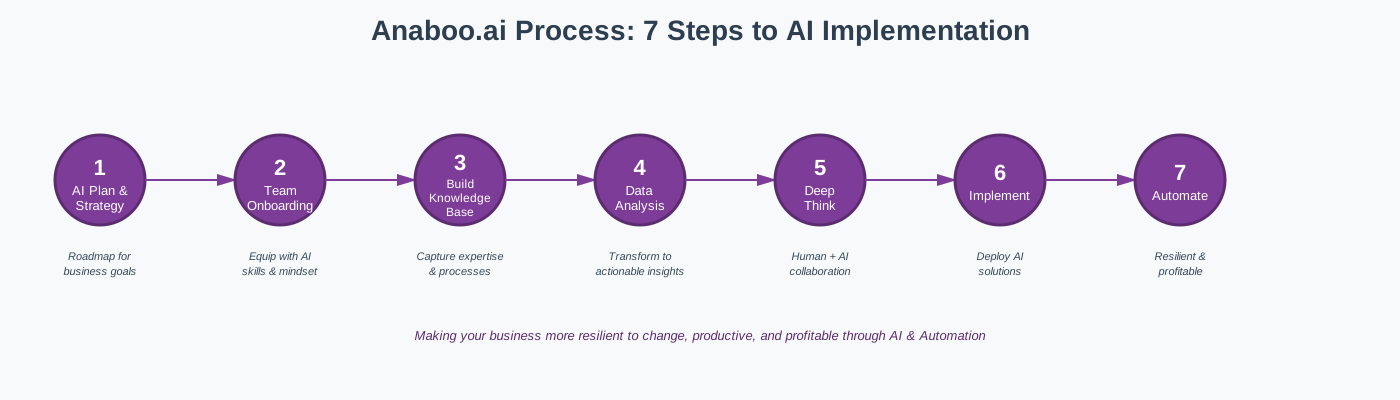
The Anaboo 7-Step Process (in Brief)
Every project at Anaboo follows this flow:
Create a Plan & Strategy (hint: we can do this with you)
Bring your Team onboard with the plan
Build Your Knowledge Base
Analyse Your Data
Deep Think (Using your team's thinking combined with Ai Deep thinking)
Process Automation (this is the implementation bit)
Regular Maintenance - (now we can scale strategically)
Use Step 1 & 2 as your compass: if the business impact isn’t clear, pause. Clarity today saves chaos tomorrow.
Next Steps: Pick One, Not Ten
At your next leadership meeting, ask:
“If we could automate one task this month that saves everyone an hour a day, what would it be?” Alternatively, "If you could automate one task for one person that saves them an hour a day, what would it be?
That’s your first AI project. Simple. Strategic. High-ROI.
If you’d like to break through the clutter and map out the first practical steps of AI in your business, book a coffee chat with the Anaboo team — no jargon, no hype, just clarity and direction.
Let’s find the use case that gives you time back, strengthens your people, and sets the stage for real growth.
Live with passion & Ai,
Brett
✅ Key Takeaways
Start small, aim big — your first AI win builds trust and momentum.
Prioritise high-impact, low-risk, and measurable outcomes.
Bake privacy and security into every step.
Review regularly to prevent prompt drift and performance decay.
Empower your team before scaling — people first, tech second.